Get a few nerds of a certain age talking about the early days of personal computing, and the same machines always come up. The Apple II gets its flowers. So does the Commodore 64. Somebody gets misty about the TRS-80.
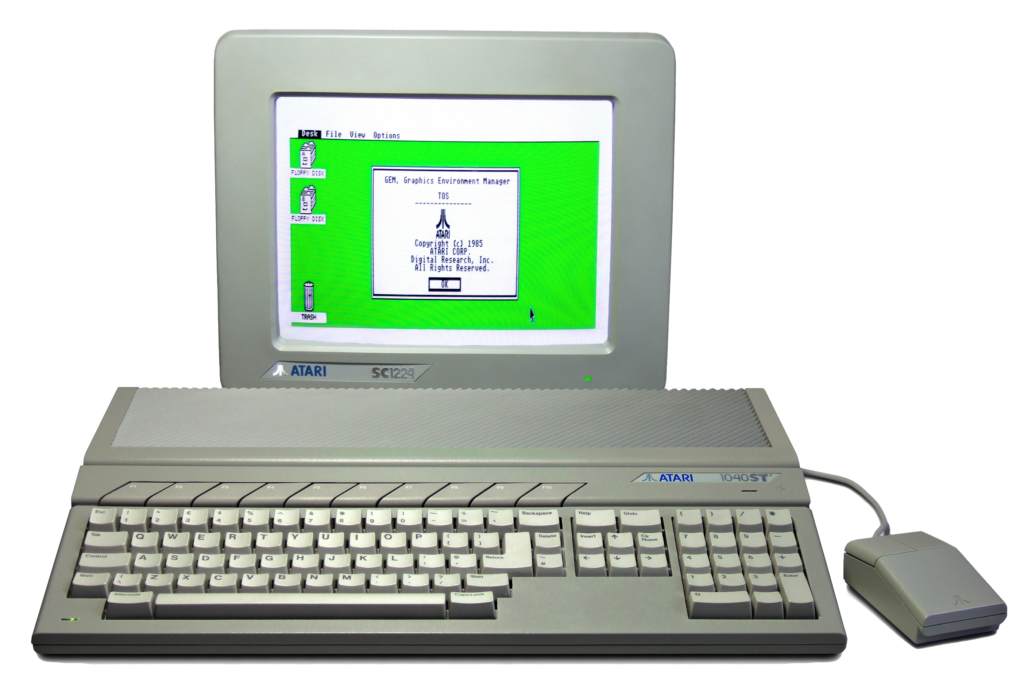
Nobody mentions the Atari ST. I’d like to fix that, because I owned one, and it was a terrific computer.
A little history. Jack Tramiel, the man who built Commodore, walked out of that company in January 1984. By July he’d bought Atari’s consumer division from Warner. His team, led by engineer Shiraz Shivji, designed the 520ST in about five months and showed it off at the Consumer Electronics Show in January 1985. It hit store shelves that summer. Concept to retail in under a year. The press nicknamed it the “Jackintosh” because it looked suspiciously like a Macintosh built to a Tramiel budget.
The budget was the whole point. Atari’s slogan was “Power Without the Price”, and for once the marketing was accurate. You got a Motorola 68000 machine with a mouse and a graphical desktop for far less than a Mac, and it was faster than a lot of what it competed against. In 1986, the 1040ST shipped with a full megabyte of RAM and became the first home computer to get memory under a dollar per kilobyte. Try explaining that pricing milestone to a kid today.
The ST had one more trick, and it’s my favorite. Built-in MIDI ports. Right there on the back, in and out, standard equipment. No interface box, no expansion card. Plug in a synthesizer and go. Musicians noticed. Cubase started life on the Atari ST. So did Notator, the ancestor of Logic Pro. Fatboy Slim made You’ve Come a Long Way, Baby on one, and Tangerine Dream leaned on STs in the studio and on stage for years. Game developers got clever with those ports too. MIDI Maze chained up to 16 STs together for networked deathmatches years before most people had heard of a LAN party.
I couldn’t afford the early Mac, but I could scrape enough together for a 520ST and I loved the thing. When I decided I needed more memory, I didn’t order an upgrade kit or take it to a shop. I cracked the case open and soldered new RAM chips directly on top of the existing ones, piggyback style. It worked! The machine ran for years afterward with double the memory. Every time someone tells me modern computers aren’t meant to be opened, I think about that afternoon.
The ST wasn’t perfect. The case felt a little cheap, and Atari never really figured out how to sell the thing in America, which is part of why it fades from these conversations. Atari wound down the ST line in 1993.
But for a stretch in the late 80s, the ST was the affordable path to real computing power, and for musicians it was the obvious choice. The Apple II and the Commodore 64 earned their nostalgia. The Atari ST earned some, too.