Timing: Time Tracking That Does the Work for You (Sponsor)

Today’s sponsor is Timing. If you’ve got “understand where my time actually goes” on your 2026 goals list, this is the app that can make it happen.

Most of us know we should track our time. Knowing how you spend your hours is the first step to spending them better. But manual time tracking is a pain. You start a timer, get interrupted, forget to switch it, and by 3 PM, your log looks like fiction. The friction kills the habit before it takes root.

Timing takes a different approach. It runs quietly in the background on your Mac, watching which apps you use, which documents you open, and which websites you visit. Then it categorizes everything automatically based on rules you define. Work in Scrivener for two hours? That’s writing time. Spend 45 minutes in Safari on research? You decide once, and Timing remembers.

What’s new is the AI summaries feature. Timing now analyzes your work and automatically groups related activities, highlighting the key topics you’ve worked on. Instead of scrolling through a raw timeline, you get an instant understanding of how your day actually went.

The app also tracks beyond your Mac. It imports Screen Time data from your iPhone and iPad, so you see your complete picture across devices. It even detects when video calls end and prompts you to log that meeting time. For anyone doing client work, this eliminates the anxiety of wondering whether you’ve captured everything accurately.

Timing is a native Mac app. Not an Electron wrapper or a web app pretending to be desktop software. It’s fast, it respects your privacy by keeping data local (unless you opt into sync), and it feels right at home on macOS. Plans start at $9/month for Professional, with Expert ($11/month) adding AI summaries and Screen Time integration, and Connect ($16/month) for team features. All plans come with a 30-day free trial.

January is the perfect time to start building this habit. Check out Timing and see exactly where your year is going.

Five New Apple Products in 2026? Yes, Please.

If the rumors are true, 2026 is shaping up to be one of Apple’s most interesting hardware years in recent memory.

According to the rumor mill, Apple has five all-new products in the pipeline: a foldable iPhone, augmented reality glasses, a HomePod with a touchscreen, home security cameras and a video doorbell, and a more affordable MacBook. That’s a lot of new territory for our favorite fruit company.

I’m genuinely optimistic about all of it.

The iPhone Fold

It’s time. I have several friends who love their Android folding phones, and I’ve watched them unfold those big screens with some envy. Apple’s late to this party, but that’s never stopped them before.

The interesting thing is that this likely creates a new kind of trade-off at the top of the iPhone lineup. I expect the iPhone Pro will still have the better camera and longer battery life.

So for the first time, there won’t be a single “best” iPhone. You’ll have to choose: big folding screen or superior camera and battery. That’s a healthy problem to have. Either way, I’m curious to see Apple’s take on a folding phone.

Augmented Reality Glasses

I expect Apple’s first steps here will be tentative. The Meta Ray-Bans have proven there’s a market for smart glasses that don’t look ridiculous.

Apple has a history of entering existing product categories and making something genuinely great. The Vision Pro showed they’re serious about spatial computing.

Lightweight AR glasses feel like the natural next step. Let’s hope they can pull it off.

HomePod with Touchscreen

This one has been rumored for years, and I’ll admit I’m strangely invested in it. I love the idea of dedicated home control centers. If Apple takes it in that direction, a HomePod with a screen could finally make the smart home feel cohesive instead of cobbled together.

The current HomePod is a good speaker with Siri bolted on. A touchscreen version could be something much more useful.

Home Security Cameras and Video Doorbell

This one is overdue. I’d love to see Apple get serious about HomeKit hardware.

Right now, finding home security products you can truly trust with your data is harder than it should be. Apple’s privacy-first approach could be a real differentiator here.

I’m not expecting them to out-feature Ring or Nest on day one, but if they nail the basics with solid Apple integration and strong privacy protections, I’m interested.

Affordable MacBook

Finally. Apple Silicon is so good that even a basic entry-level chip would make for a genuinely capable computer.

There are a lot of people who need a Mac for school, for basic work, for browsing the web. They don’t need an M4 Pro.

An affordable MacBook with an efficient Apple Silicon chip would serve them well and bring more people into the Mac ecosystem. I sincerely hope this one comes to life.

Will They Actually Ship?

Five new product categories in a single year is ambitious. Will Apple actually ship all of them in 2026? Maybe not.

But even if we get three or four, it’s going to be a fun year to be an Apple nerd.

Solving for Meaningfulness

In productivity, we worship efficiency. The fastest way to clear an inbox. The most automated way to track a project. The most frictionless method to organize our lives.

I’m going to suggest something different.

When it comes to your goals and plans, efficiency is the enemy.

I learned this the hard way last year. Trying to be hyper-efficient, I dictated my quarterly review and used AI to organize the text into a structured plan. The resulting document was thorough and efficiently produced.

It failed completely.

A picture of David's hand written Q1 Plan
My Q1 plan was hand written for a reason.

By skipping the struggle of manually organizing my thoughts, I hadn’t actually internalized the goals. The plan remained a digital file rather than a core part of my squishy human brain. The process of birthing the ideas is what makes them sink into your core.

I learned, again, that you cannot optimize the pursuit of virtue and your character.

Much of the tech industry has monetized us as advertising units, designing tools that prioritize engagement and speed over our personal flourishing. Choosing to go intentionally slow is an act of rebellion. It’s the refusal to live your life randomly.

The world will try to bury you with petty nonsense. Everyone has good intentions when they ask for just one more little thing. But every “yes” to the unimportant is a “no” to what actually matters.

Solving for meaningfulness means giving yourself permission to ignore the siren song of doing more. It means taking an hour in the morning to read and reflect, or taking two days for a personal retreat, even when your inbox is screaming.

These aren’t inefficient uses of time. They’re the highest and best use of your life because they ensure you’re actually heading toward a destination that matters.

As we enter a new year, resist the temptation to optimize everything.

Some things deserve to be slow. That’s where the meaning lives.

The 2026 Focused Calendar

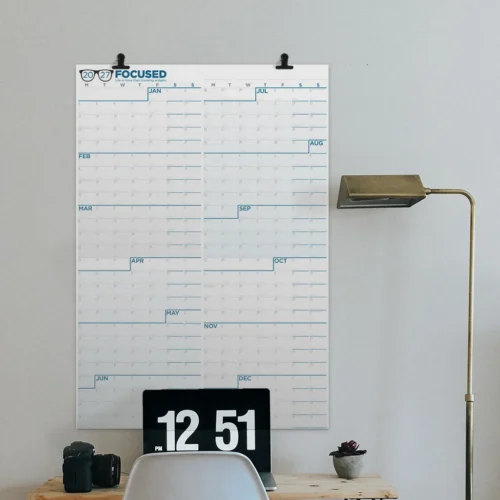
It’s not too late to get the Focused Wall Calendar for 2026. Mike and I have been collaborating with the NeuYear folks for years, and this is, in my opinion, the best wall calendar on the market.

We’ve spent a lot of time tweaking this calendar over the years to get it just right. Here are some of the features I love:

  • It starts on Monday, as a proper calendar should.
  • It’s big at 25 inches by 36 inches. This isn’t one of those calendars you have to squint at.
  • The year-at-a-glance view is invaluable. Over the years, this calendar on my wall has gotten me out of a lot of pickles as I look at the calendar to see just how busy I am before I say yes to another commitment. There’s something about seeing three weeks of wall-to-wall appointments that makes saying no much easier.
  • It’s designed with no gaps between the months. The philosophy is simple: we think in weeks, not months. This calendar presents 52 weeks as a continuous flow, which makes it easy to see the distance between any two dates and plan across months without artificial boundaries.
  • You can write on it with dry-erase or wet-erase markers. I’ve tried both, and they both work great. The dry-erase is better if you’re constantly adjusting things, while wet-erase stays put better for long-term commitments.
  • It’s two calendars in one. Flip it over and you get a different orientation. One side is portrait, the other landscape. I keep mine in landscape above my desk, but you can hang it vertically on a door if that works better for your space.
  • The quarterly shading is genius. The calendar breaks the year into four quarters with background shading, making it easy to set quarterly goals and see reset points throughout the year. Buffer weeks are built in so you can review what worked, celebrate wins, and adjust course if needed.
  • The habit tracking system at the bottom lets you create your own color-coded system. Each day has space to track up to four habits, and it shows you how many days are left in the quarter to keep you honest.

It’s beautiful. This matters more than you might think. When your productivity tool looks good, you actually want to use it. Attraction breeds commitment.

You can buy it now. Mine is already on order.

PowerPhotos 3.0: The Power Tools Apple Photos Needs (Sponsor)

I’m pleased to welcome back PowerPhotos as a MacSparky sponsor. If you’ve used Apple Photos for any length of time, you know the app is missing serious power-user tools. PowerPhotos fills those gaps beautifully.

The app has long been the go-to utility for managing Apple Photos libraries. Need to merge multiple libraries into one while keeping your albums, edits, and metadata intact? PowerPhotos does that. Want to split an oversized library into smaller, more manageable ones? Done. Looking to hunt down and eliminate duplicate photos clogging up your drive and iCloud storage? PowerPhotos has a powerful duplicate finder that handles it.

What’s New in Version 3.0

The newly-released PowerPhotos 3.0 is a significant update with some useful new features:

  • Batch metadata editing — Edit photo titles, captions, and keywords directly in PowerPhotos, with keyboard-focused editing that makes tagging and organizing photos fast
  • Advanced search engine — A new indexing system with nested predicates lets you search by criteria Photos doesn’t support, like file size, dimensions, and video duration. You can save your smart searches too.
  • Enhanced photo browser — The browser is now faster with live updating as your library changes, plus new export options including XMP support and whole library export

PowerPhotos 3.0 is a paid upgrade. If you’re an existing user of PowerPhotos 2 or earlier (or even the old iPhoto Library Manager from way back), you can enter your old license key for 50% off. Everyone can use the coupon code MACSPARKY26 for 20% off both regular and upgrade orders.

If you want to go deeper, Brian Webster (the developer behind PowerPhotos) joined Stephen and me on Mac Power Users episode #810 to talk about the app and its features.

Check out PowerPhotos today.

December in the MacSparky Labs

December was a busy month in the MacSparky Labs!

There were four weekly Lab Reports to keep members up-to-date with Apple news, a Deep Dive on Year End Tech Stack Audits, a Book Club meeting on Apple in China, a Jam Session on Career Transitions and Retirement, and videos on topics like Apple Music and ChatGPT. And much more.

Here’s what took place in the Labs for the month of December 2025:

  • 2025-12-29 – MacSparky’s Life Update 2025 (Video) (M,I,P)
  • 2025-12-26 – The Lab Report for December 26, 2025 (M,I,P)
  • 2025-12-24 – Apple Music and ChatGPT (M,I,P)
  • 2025-12-23 – Using MCP with Third-Party Software on the Mac (I,P)
  • 2025-12-19 – Deep Dive – Year End Tech Stack Audits (Labs Podcast) (P)
  • 2025-12-19 – Email Linking Script Update (and Keyboard Maestro Script Execution) (M,I,P)
  • 2025-12-19 – Lab Report 2025-12-19 (M,I,P)
  • 2025-12-17 – Getting Links to Apple Notes Using Keyboard Maestro (I,P)
  • 2025-12-14 – Book Club 005 – Apple in China (Podcast) (M,I,P)
  • 2025-12-13 – Jam Session 005 – Career Transitions and Retirement (Podcast) (I,P)
  • 2025-12-12 – Deep Dive – Year End Tech Stack Audits (Event) (P)
  • 2025-12-12 – The Lab Report for December 12, 2025 (M,I,P)
  • 2025-12-12 – Book Club 005 – Apple in China (media release) (M,I,P)
  • 2025-12-11 – Jam Session 005 – Career Transitions and Retirement (Podcast) (I,P)
  • 2025-12-10 – Labs Momentum Club (I,P)
  • 2025-12-10 – Using PCC for Adding Tasks to Reminders (M,I,P)
  • 2025-12-10 – December Labs Meetup (Media Release) (I,P)
  • 2025-12-05 – Book Club: Apple in China (webinar) (M,I,P)
  • 2025-12-05 – The Lab Report for December 5, 2025 (M,I,P)
  • 2025-12-04 – Dictation Series 02 – Wispr Flow (Video) (M,I,P)
  • 2025-12-04 – Jam Session 005 – Career Transitions and Retirement (Event) (I,P)
  • 2025-12-03 – Labs Meetup (Event) (I,P)

If you’d like to be a part of the MacSparky Labs, you can get more information and join right here.